

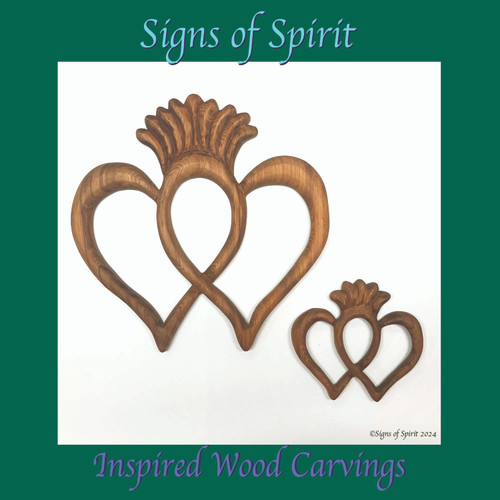
Scottish Luckenbooth Wood Carved Symbol of Love and Devotion, Gift for Nursing Mother, Protection of Children, wall hanging.
Variations: We have 3. A simple Double Heart measuring 10.5 inches wide by 10.5 inches tall. The same design in Miniature is 5.5 inches by 5.5. The Thistle Luckenbooth is a double heart with a Scottish Thistle flower in the center, the leaves within the outer edges. This measures
MEANING: This carving is inspired by the Scottish brooch known as the Luckenbooth.
The name comes from the Luckenbooths of Edinburgh, where jewelry and trinkets were sold. Luckenbooth is a Scots word for a lockable stall or workshop. The Edinburgh booths, initially housing mainly silver and goldsmiths, were situated on the Royal Mile near St Giles Cathedral and were the city's first permanent shops, going back to the 15th century. They were demolished in 1817.
The Luckenbooth brooch is a traditional Scottish love token: often given as a betrothal or wedding brooch. It might be worn by a nursing mother as a charm to help her milk flow, and/or be pinned to a baby's clothing to protect it from harm. It was known as a witch-brooch by people who used it to save children from the evil eye.
One legend of the Luckenbooth brooch is that it was a symbol of love and devotion given by Mary Queen of Scots to Lord Darnley. Another story is that it was an engagement brooch given to her by the Dauphin of France, whom she later married.
THE CARVING: Our carvings are single pieces of western red cedar, designed and carved to be wall hangings. Each carving begins as a 1 X 12-inch cedar board. While we use power tools (Scroll Saw, Rotary shaft Tool, handheld detail sanders, etc.), we use no lasers, CNC machines or computer-operated cutting machines. All work is done with our hands and eyes…
We cut the 2-dimensional blanks with scroll and jig saws (double-sized custom orders have to be cut with a jigsaw). Carving is done with rotary shaft tools and disc grinders. The 80-grit sanding is the final phase of the carving process, removing the nicks and gouges from the carving tools, and finishes the shaping of the weave. The next 2 sandings with 120 and then 220 grit finishes the smoothing and polishing. They are finished with Clear Danish Oil to seal the piece, bringing out the grain and the color.